


Why I Built Hejme, Part 2: What I Know About Your Data
First published at Tuesday, 13 January 2026
Why I Built Hejme, Part 2: What I Know About Your Data
I've spent two decades building software. I've been a chief technology officer (CTO), a VP Engineering, a founder multiple times. I've architected platforms that processed hundreds of millions in revenue. I've sat in the meetings where decisions about user data get made.
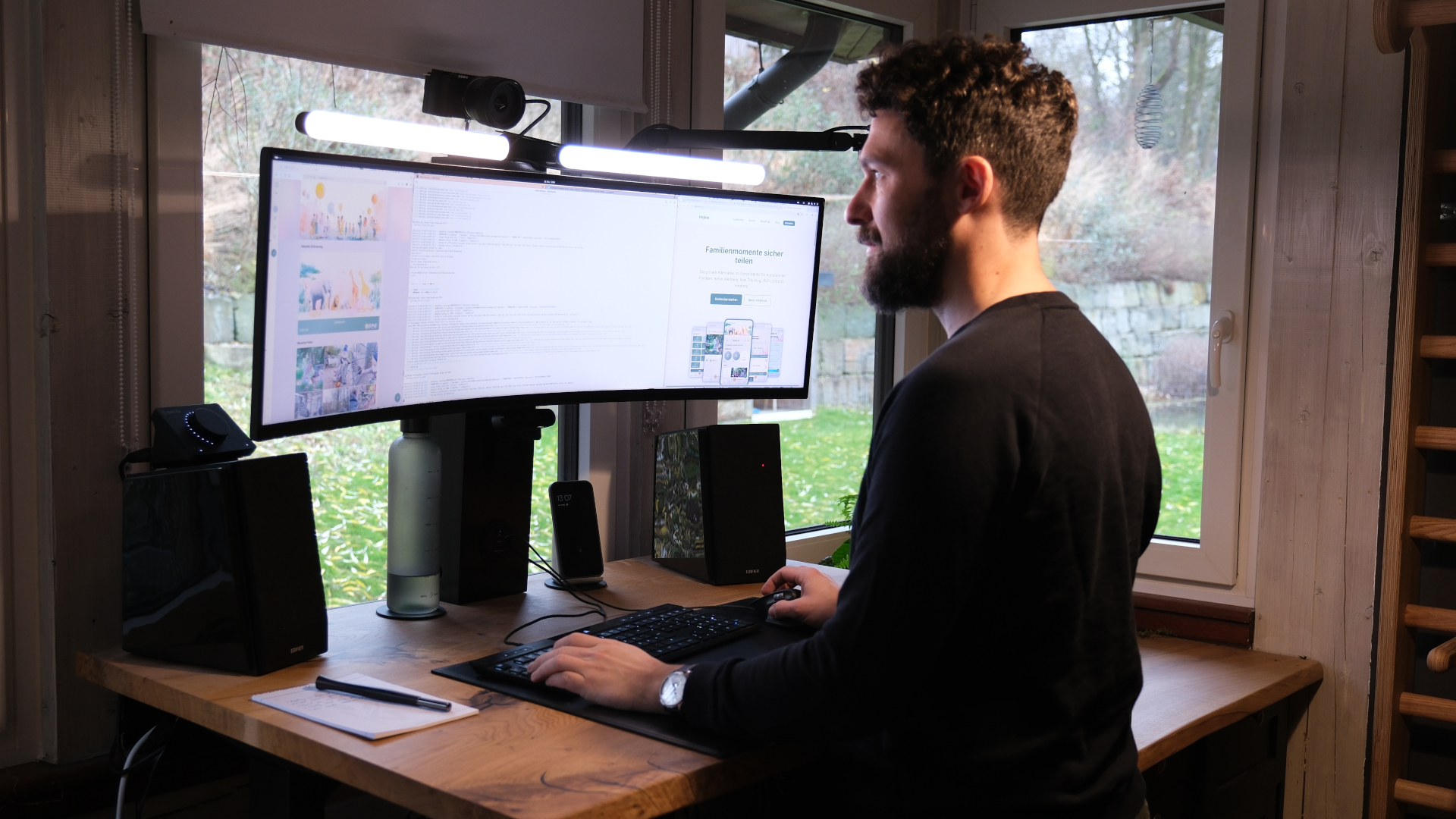 Kore staring at a screen at his standing desk
Companies will always extract maximum value from your data. They are not evil or run by bad people, that is simply what shareholders and the business model demand.
When a product is free, the company needs another revenue source. The only asset they have is you, your attention, your behaviour, your content, your relationships. So they optimise for extraction. More time on platform. More data collected. More signals to sell to advertisers. There is no conspiracy behind this, just economics.
The algorithm that buried my brother's vacation photos wasn't malfunctioning. It did exactly what it was built to do: maximise engagement and with it ad revenue. Calm, peaceful family photos don't achieve that, so the system learned to bury the peaceful and surface the inflammatory.
Your children's faces become training data for AI systems you'll never see. Your family moments become engagement bait, hooks to keep you scrolling past the next ad. Your attention becomes inventory, sold in milliseconds to advertisers you'll never know about.
I'm not telling you this to scare you or to moralize. I'm telling you because I've seen the spreadsheets. I understand how the math works.
And it doesn't have to work this way. So I started building an alternative. I call it Hejme.
But that raises an obvious question, one that's been keeping me up at night for months: what would make you trust a stranger with your family photos?
I'm asking you to upload pictures of your children to a platform built by someone you've never met. That's a significant thing to ask. It should feel significant.
"Trust me" isn't enough. Every founder says that. Every privacy policy claims to protect you. Every platform promises they're different – until they get acquired and the new owners have different priorities. Until the business model shifts and your data becomes an asset to monetize. Until the venture capital (VC) money runs out and suddenly your family photos are collateral in a bankruptcy proceeding.
I've watched this happen to companies I respected. The promises made in year one rarely survive to year five.
 Kore asking: What would you make trust a stranger with your family photos?
So what would earn your trust? This is what I can offer:
No tracking. Not "limited tracking" or "anonymized tracking" or "tracking to improve your experience." None. I don't want to know what you click, analyse your behaviour, or build a profile of your preferences. I want to show you your family's photos. That's the entire job.
No ads, ever. The moment you introduce advertising, you introduce the misaligned incentives that created this mess in the first place. Your attention becomes the product. I would rather charge you a few euros a month and work for you directly.
European hosting under European law. Your data stays in Europe, under the General Data Protection Regulation (GDPR) and European jurisdiction. This is one of the reasons I'm building this in Germany rather than on US infrastructure. After watching what American tech companies do with user data, and watching how American law enables it, I want European legal protection for European families.
Bootstrapped. Built with my money and no VC money.
No algorithm deciding what you see. Your sister posts a photo, you see it. That's the entire feature. No engagement optimization, no "relevance" ranking, no machine learning model deciding what's important to you. Just new photos from your family, in chronological order.
Is this enough? I don't know.
Maybe trust can only be built over time. Maybe you need to see a track record, years of doing exactly what I said I'd do, resisting the temptations that corrupted other platforms. Maybe you need other families to go first and report back that it's safe.
I can't shortcut that process. I can only start it.
What I can promise is this: the business model is subscriptions. You pay, I work for you. There's no hidden customer, no advertiser whose interests conflict with yours. The incentives are aligned from day one.
Subscribe to updates
There are multiple ways to stay updated with new posts on my blog:
